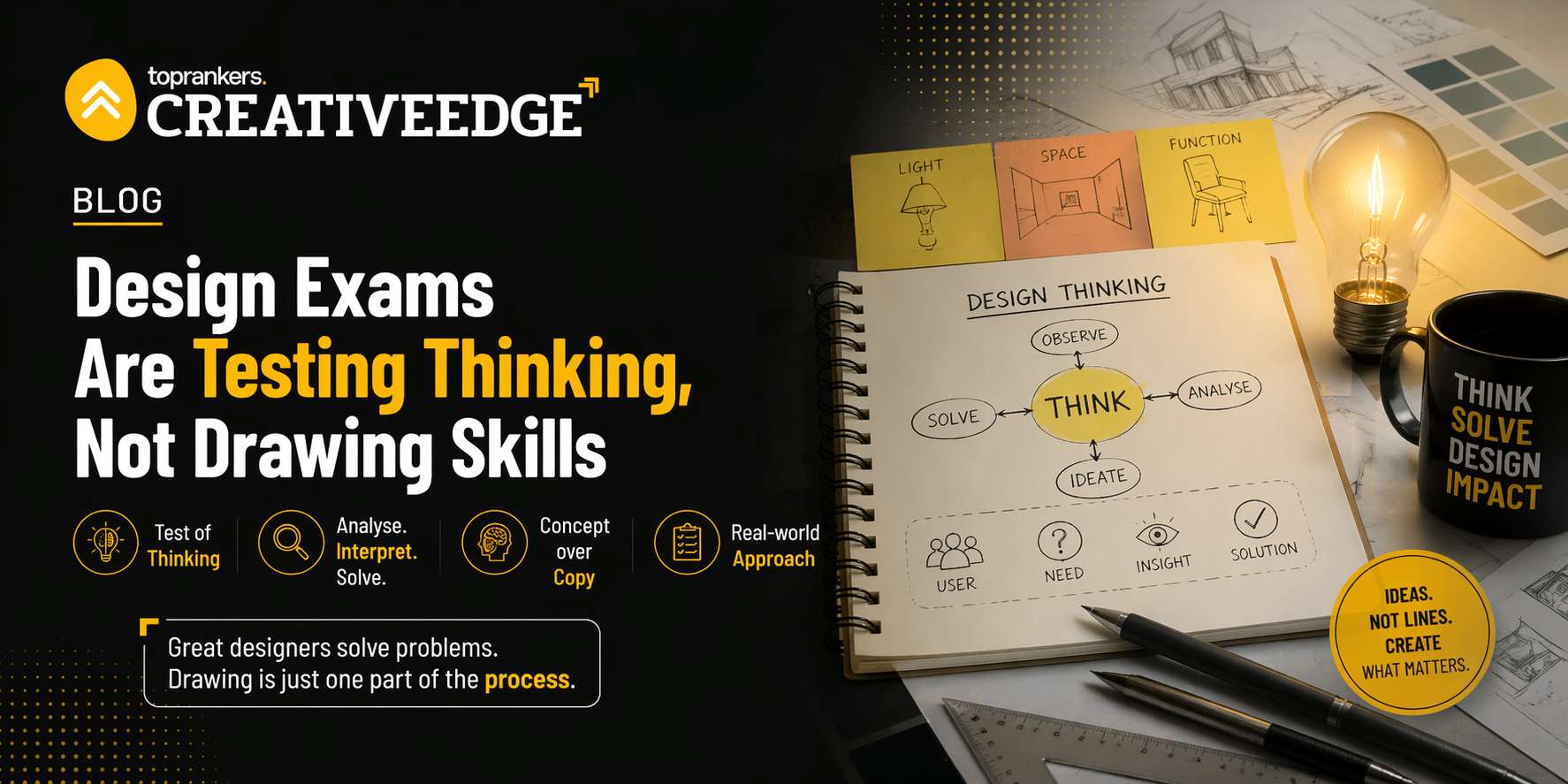
A major shift is underway in how India’s top design entrance exams are being evaluated. According to experts at Creative Edge, exams like NID and UCEED are no longer rewarding students for how well they draw—but for how well they think.
This shift is changing the way students should approach preparation, especially those who believe that drawing talent is a prerequisite for success.
The Biggest Myth: “Good Drawing = Selection”
“For years, students have assumed that strong sketching skills guarantee selection in design exams. That’s simply not true anymore,” says Creative Edge.
Addressing a common concern— “Do I need drawing skills for NID or UCEED?”—experts clarify that drawing is only a medium of expression, not the core skill being tested.
Students are instead evaluated on:
- Observation and interpretation
- Idea generation
- Problem-solving ability
- Clarity of thought
In fact, many successful candidates demonstrate average drawing ability but excel in conceptual thinking.
What Design Entrance Exams Actually Test
Design exams today are structured to assess how candidates approach real-world problems. Questions are increasingly:
- Situation-based
- Open-ended
- Context-driven
Instead of asking students to replicate visuals, exams now test:
- How you interpret a scenario
- How creatively you respond
- How effectively you communicate an idea
This directly answers another key query— “What do design entrance exams actually test?”—with a clear shift towards thinking over technique.
Creativity vs Drawing: What Matters More?
“Creativity is not about artistic perfection. It’s about originality and relevance,” explains an expert from Creative Edge.
When students ask, “Is creativity more important than drawing?”, the answer is increasingly evident in exam patterns:
✔ Creativity drives selection
✔ Drawing supports communication
A simple sketch backed by a strong idea often scores higher than a visually polished but conceptually weak answer.
Why Students Struggle Despite Preparation
One of the most overlooked aspects of design preparation is misdirected effort.
Many aspirants:
- Spend hours copying sketches
- Focus only on improving drawing speed
- Ignore idea-building exercises
This leads to a critical gap—students improve visually but not cognitively.
“Why do students fail in design exams despite preparation? Because they train their hand, not their mind,” notes the faculty at Creative Edge.
Preparing Without Strong Drawing Skills
A growing number of aspirants now come from non-art backgrounds—commerce, science, and even engineering streams. This raises a key concern:
“How to prepare for design exams without drawing?”
Experts suggest focusing on:
- Daily observation of surroundings
- Analysing product designs and user experiences
- Practising idea generation from real-life problems
- Learning structured thinking frameworks
At Creative Edge, students are trained to follow a simple approach:
Observe → Interpret → Create
This helps build design aptitude even in those with minimal artistic exposure.
How to Improve Design Thinking
Improving design thinking is not about talent—it is about training the brain to see differently.
Students are encouraged to:
- Question everyday objects and their usability
- Break down problems into smaller parts
- Explore multiple solutions instead of one
- Focus on clarity before aesthetics
This structured approach is increasingly becoming the foundation of modern design entrance exam coaching, where the emphasis is on developing thinking frameworks rather than artistic replication.
A Shift That Expands Opportunities
This evolution in exam patterns is also making design more accessible.
Students who once believed:
“I can’t draw, so I can’t crack design exams”
are now realising that:
- Logical thinkers
- Observant individuals
- Problem solvers
have an equal, if not greater, chance of success.
Parents evaluating design as a career are also beginning to recognise that it is no longer limited to artistic students, but open to those with creative intelligence and analytical ability.
The New Rule of Design Preparation
As design exams continue to evolve, one principle stands clear:
Success is no longer defined by how well you draw—but by how well you think.
This shift, as highlighted by Creative Edge, is redefining preparation strategies across the country and opening doors for a broader range of aspirants to pursue careers in design.