
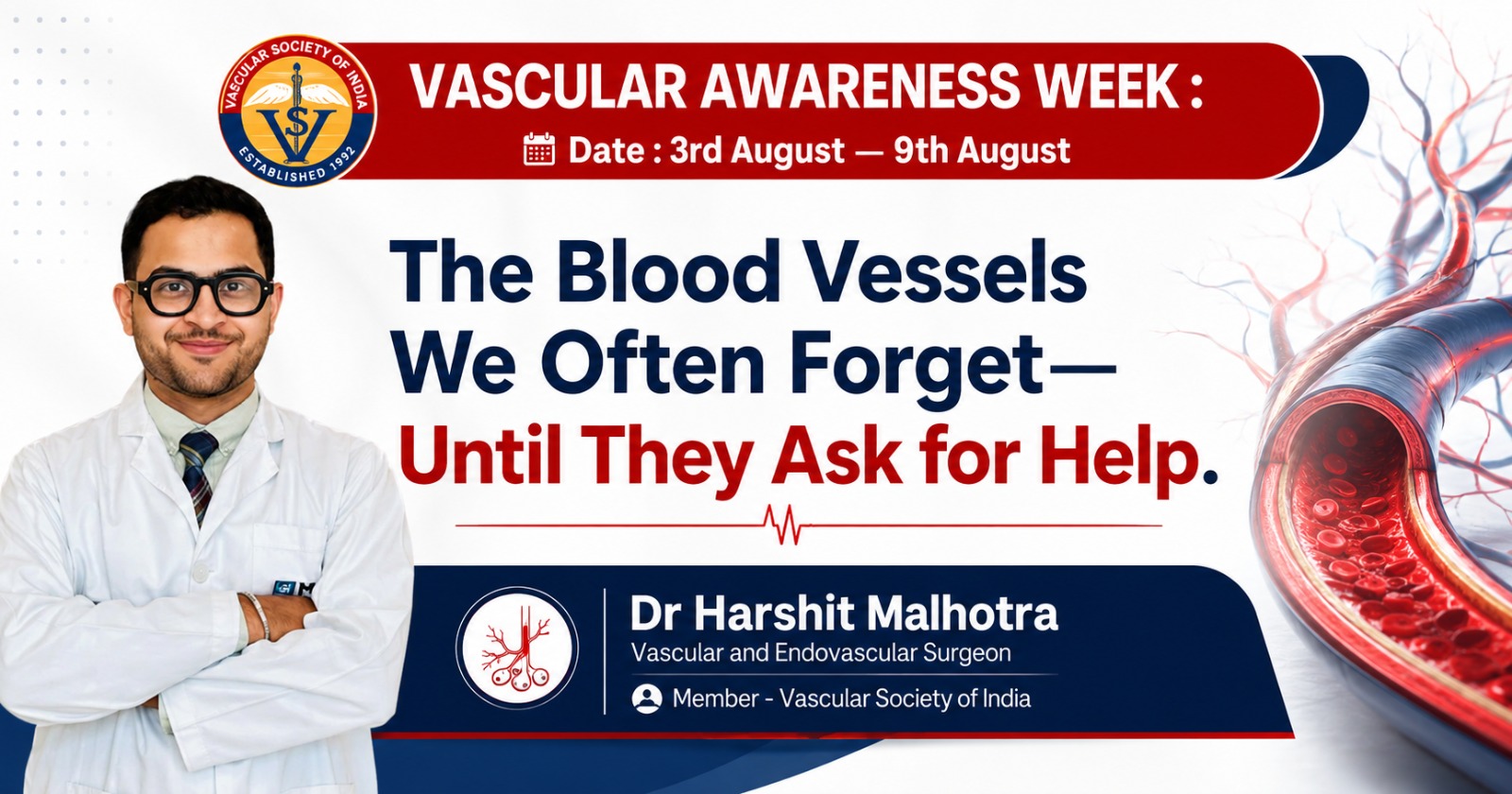
By Dr. Harshit Malhotra
Every year, we celebrate different specialties in medicine. Some are instantly recognised because the organs they treat are familiar to everyone.
The heart.
The brain.
The lungs.
Yet there is another system that silently connects every one of them.
Our blood vessels.
They form nearly 100,000 kilometres of highways within the human body, carrying oxygen and nutrients to every organ, every muscle and every cell. When these vessels become diseased, the consequences extend far beyond pain. They may lead to stroke, limb loss, kidney failure, aneurysm rupture, chronic wounds, or even death.
Despite this, vascular disease remains one of the least recognised health problems among the general public.
As a Vascular & Endovascular Surgeon, one of the most common statements I hear is:
“I didn’t know there was a specialist for blood vessel diseases.”
That is precisely why Vascular Surgery Day is important.
It is not merely a celebration of a specialty. It is an opportunity to spread awareness about conditions that are common, potentially serious, and—most importantly—often treatable when identified early.
Modern vascular surgery is far more than major open operations.
Today, treatment may involve lifestyle modification, medications, minimally invasive catheter-based procedures, endovascular interventions, traditional surgery, or a carefully planned combination of these approaches. The objective is never to perform a procedure simply because it is possible.
The objective is to choose the most appropriate treatment for the individual patient.
This philosophy lies at the heart of vascular care.
A patient with a blocked artery does not always require a stent.
A patient with varicose veins does not always require surgery.
A diabetic foot ulcer does not always end in amputation.
Every patient deserves a thorough evaluation, an accurate diagnosis, and an evidence-based discussion of all appropriate treatment options.
Equally important is recognising the warning signs.
Pain in the legs while walking that improves with rest, wounds that refuse to heal, sudden swelling of one leg, enlarged varicose veins, severe abdominal or back pain due to an aneurysm, cold or discoloured limbs, or numbness and weakness developing suddenly—these symptoms should never be dismissed as “just ageing.”
Timely evaluation can often prevent devastating complications.
Vascular surgery is also unique because it bridges multiple disciplines. We work closely with physicians, diabetologists, cardiologists, nephrologists, neurologists, plastic surgeons, orthopaedic surgeons, wound-care specialists, radiologists, anaesthesiologists, nurses, and rehabilitation teams. The best outcomes are achieved not by one individual, but by coordinated multidisciplinary care.
On this Vascular Surgery Day, I encourage everyone to remember one simple message:
Healthy blood vessels are fundamental to a healthy life.
Take care of diabetes, blood pressure, cholesterol, and kidney disease.
Stop smoking.
Stay physically active.
Seek medical attention when symptoms appear.
Do not ignore your circulation.
For my colleagues, teachers, mentors, nursing teams, technicians, residents, and every healthcare professional working tirelessly in vascular care, today is also a moment of gratitude. Every successful limb saved, every aneurysm repaired, every dialysis access created, and every patient who walks home because circulation was restored is the result of teamwork, dedication, and continuous learning.
Medicine continues to evolve, and so does vascular surgery. New technologies, better imaging, refined endovascular techniques, and stronger scientific evidence continue to improve patient outcomes. Yet one principle remains unchanged:
Patients come first. Procedures come second.
On this Vascular Surgery Day, let us continue building awareness, promoting prevention, embracing evidence-based practice, and ensuring that every patient receives not merely a treatment—but the right treatment, at the right time, for the right reason.
Because preserving circulation often means preserving independence, preserving mobility, and sometimes, preserving life itself.
