
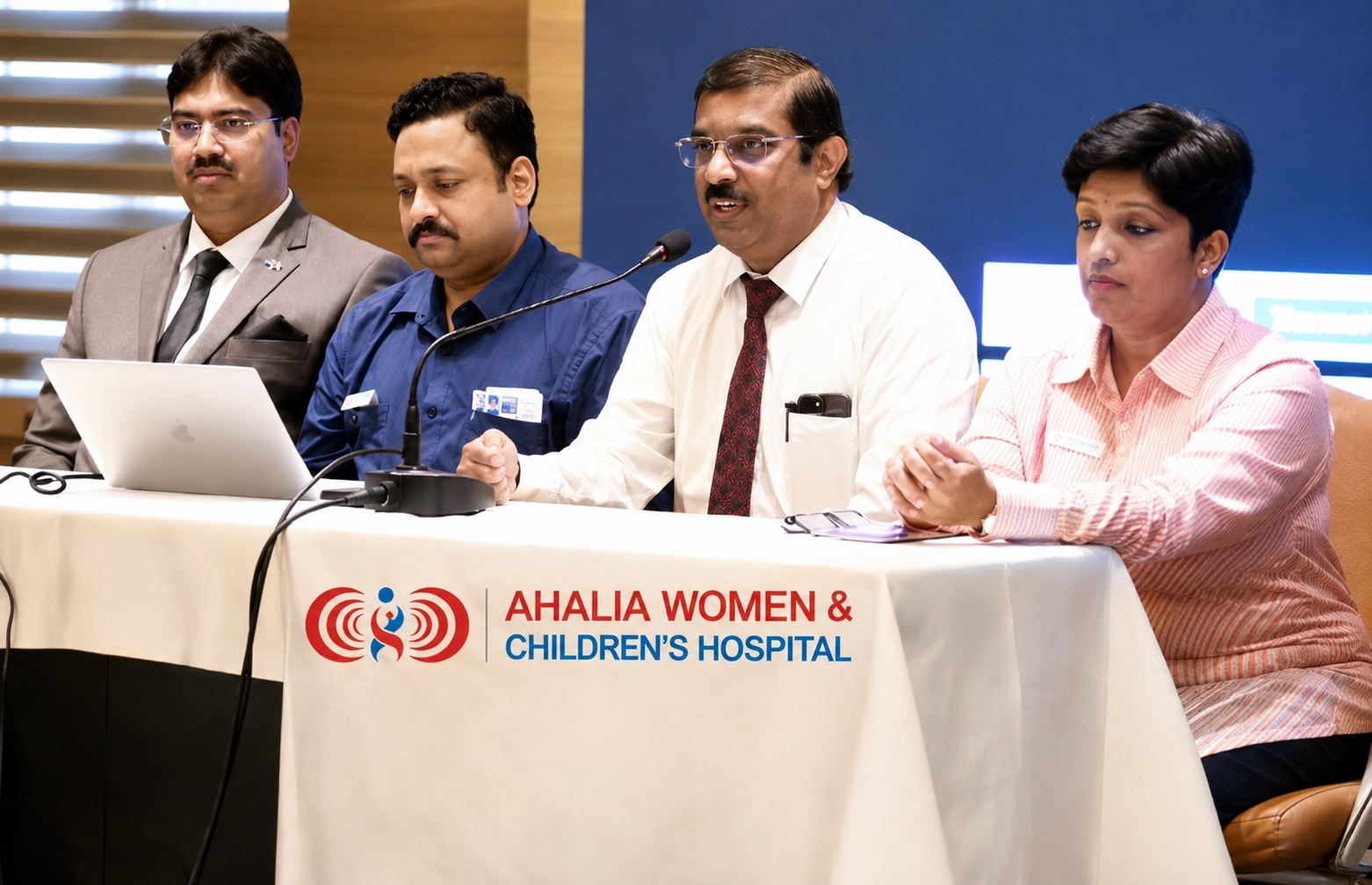
Palakkad, Kerala, India, July 30, 2026– History Created at Ahalia Women & Children’s Hospital- India’s. How long does a newborn baby usually remain in a Neonatal Intensive Care Unit (NICU)? Most babies are discharged within a few days, while some critically ill newborns may require a few weeks of intensive care. However, baby Amaana has spent the first 1 year of her life in the NICU at Ahalia Women and Children’s Hospital, making her journey one of extraordinary resilience, perseverance, and hope.
Amaana was referred to Ahalia NICU shortly after birth with bilious vomiting. Emergency evaluation led to an exploratory laparotomy by Pediatric Surgeon Dr. Muthulingam, which revealed an exceptionally rare and severe congenital intestinal abnormality- ‘Type IV Ileal atresia’. The baby had only five to six short segments of ileum. Following meticulous reconstruction, preserving every possible segment of bowel, the total remaining ileal length was only approximately 15 cm, compared with the normal neonatal ileal length of 150–180 cm. During the first month of life, she required two additional abdominal surgeries.
Post-operatively, this baby was managed in Ahalia Level III NICU by Neonatologists Dr Padmesh Vadakepat (Head of the Department) and Dr Rathnapratheep (Consultant). The baby subsequently developed Short Bowel Syndrome with Intestinal Failure, a life- threatening condition in which the intestine is unable to absorb adequate nutrients and fluids.
Even minimal feeds resulted in vomiting or profuse watery stools with virtually no absorption. Despite multiple evidence-based feeding strategies, she remained dependent on Total Parenteral Nutrition (TPN) where all nutrients including carbohydrates, lipids, proteins, micronutrients are administered through a central venous catheter. Throughout these 11 months, specially formulated TPN solutions were prepared under strict aseptic conditions in a laminar airflow chamber by the dedicated NICU nursing team.
Throughout this prolonged and challenging journey, Amaana displayed remarkable determination. Equally inspiring was the unwavering faith and resilience of her parents, who stood by every medical decision and raised financial support through crowd funding to meet the enormous treatment expenses.
The medical team sought expert opinions from several leading pediatric surgical centres across India. Given the complexity of the condition, there were no additional surgical options offered within the country at that time.
During this search for solutions, the team established contact with two internationally renowned pediatric surgeons—Dr. Basem A. Khalil, a British Pediatric Surgeon based in Dubai, and Dr. Saleem Mammoo, based in Qatar—both internationally recognised for their expertise in Serial Transverse Enteroplasty (STEP) and advanced intestinal lengthening procedures. Following multiple virtual discussions, both surgeons graciously agreed to travelto India to operate on the child. However, another major challenge lay ahead. Since the surgeons were foreign nationals, obtaining temporary medical registration from the National Medical Commission (NMC) was essential before surgery could be performed. The approval process extended over nearly three months and involved extensive correspondence and representations to multiple authorities.
Just as the regulatory approvals were nearing completion, international travel disruptions related to the conflict in the Middle East caused further delays in the surgeons’ arrival.
Despite these unforeseen obstacles, the Intestinal Lengthening Surgery (STEP/MASTEP) was eventually performed successfully when the baby was 11 months old, at Ahalia Women and Children’s Hospital by Dr. Basem A. Khalil, Dr. Saleem Mammoo, and Dr Muthulingam, ably supported by the Anaesthesiology Department and OT Staff. Post-operative period was uneventful without complications.
Dr Padmesh explained that the outcome has been highly encouraging. Amaana has now been successfully weaned off TPN for three days each week, is tolerating 120–150 ml of milk every three hours, and has begun taking solid foods. She continues to make steady progress and, although she still requires ongoing hospital care and nutritional rehabilitation, she is now firmly on the path towards recovery.
This landmark procedure represents the first reported performance in India of STEP with Modified Angular STEP (MASTEP) involving the duodenum, offering new hope for children with severe short bowel syndrome and intestinal failure. It demonstrates that advanced intestinal rehabilitation procedures can now be successfully performed within India, potentially transforming the outlook for infants who previously had extremely limited treatment options.
The successful management of baby Amaana reflects the power of multidisciplinary teamwork, parental trust, international collaboration, and unwavering commitment to providing advanced care for children with the most complex medical conditions.
